NOTES · FROM THE LANDING PAGE
A hall holds two hundred people. The internet does not have a hall.
Fifteen people deliberating over the web is not the hard part; the method has done that for years. The hard part is forty rooms of fifteen working the same question and ending with one answer — then four thousand, with no one's load growing. That needs four things: knowing when two groups said the same thing, carrying a claim two groups raised to the few groups most likely to judge it, sending a deadlock where it can be settled, and folding every local map into one. The method's own recent work comes closest to the last: asynchronous individual maps used to extend a session's map (Laouris, 2023), and thematic maps merged in a final session of their authors (Michaelides & Laouris, 2024). What had not been built is doing it for thousands of rooms, with no session to merge them.
Three things bind a co-laboratory to its venue: everyone reads the same wall, one facilitator holds every thread, and the room decides what a claim means. Each has a counterpart here that does not need the room.
Every group gets its own wall
Participants work in small groups — small enough that everyone reads the whole wall. Once a room grows past that, it is split into groups, each with its own wall, and the room's map holds them all. Nobody's load grows with the room: one person's work is the same whether the question has fifteen participants or two million.
The same question, wherever it is asked
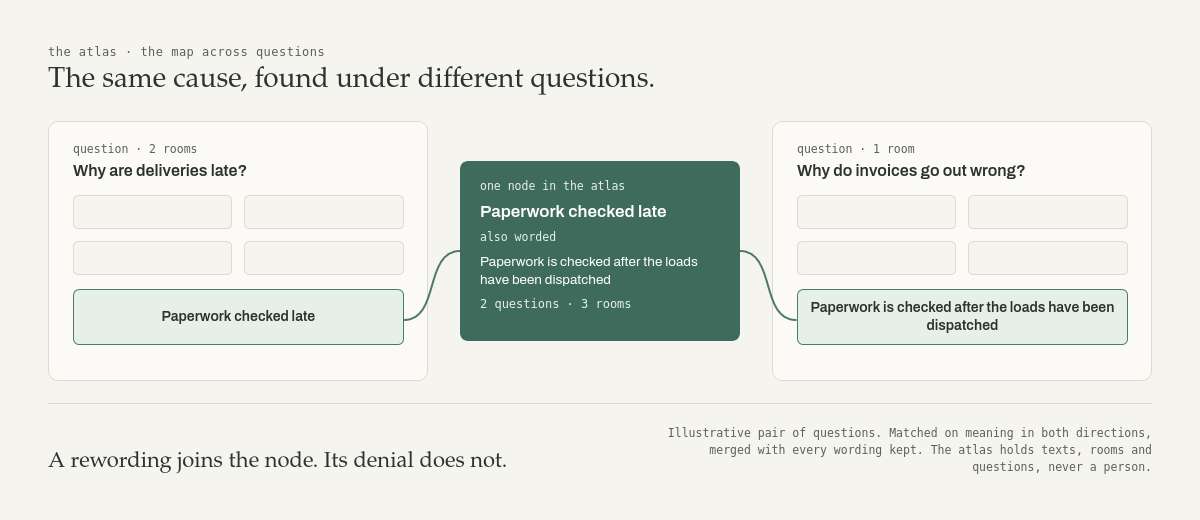
A room is not the unit — the question is. Open a dialogue and the platform recognises other rooms already asking it, however differently worded, and joins them into one deliberation. Their groups become groups of the same question, and claims move between all of them.
A few ideas travel; people don't
The same claim written in two groups is counted as one claim raised by two groups. That single choice is what makes scale computable: without it, a claim in forty rooms is forty items and nothing can be counted at all. Between rooms, a few cards travel — after a room has finished generating and before it starts clarifying, so nothing arrives while people are still thinking for themselves. A wall never receives a card it already holds in other words, and takes only a few at a time, chosen against what it already holds — including, where there is one, a card that contradicts it — so a wall stays a wall whatever the number of rooms. They arrive with their author's clarification, as ordinary cards, and are judged like any other.
How two wordings become one claim
Counting groups only means something if you can tell when two of them said the same thing in different words. The platform spots the likely pairs and puts them to the people who wrote them. It never merges anything itself: two members have to agree that two wordings are one claim, and either can take it back.
The asymmetry is deliberate. A false merge is an attack — fold your claim into a popular one and you inherit its support — while a missed merge only costs a little efficiency, since the claim still travels as two items instead of one. Claims that contradict or reverse each other are never offered as the same claim, however similar they look.
Every group's map becomes one map
Each group structures the wall it actually deliberated on and produces its own map. Those maps are then folded together: the same claim is one node, every connection carries how many groups certified it independently, feedback loops collapse into single deep causes, and roots are read off the merged graph. Where two groups certified opposite things, the contradiction is published as a conflict and is referred, like any deadlock, to two other groups that must agree — never averaged away.
Why small groups. Below about a dozen people, a panel starts losing causes; above the size a person can read as one wall and follow as one conversation, it gains nothing — the size the method's practitioners settled on across a hundred and twenty dialogues. So scale comes from more groups, not bigger ones.
Where a deadlock goes. Not back to the group that split, and not to everyone. The question is referred to two other whole groups, chosen in a way nobody can steer toward a friendly audience. Each answers on its own, and they have to agree — if they don't, the pair is published as contested. One group is never enough: in simulation a single referral hands back a wrong answer 29.6% of the time under attack, where two or more does not.
What it costs to rig. Three people coordinating to bury one cause hold it to 40% of where it should be, and touch nothing else. Referral to other groups takes it back to 62%. The rest is closed by seats — a way onto the shortlist that does not run through the people trying to keep it off. Astroturfing the vote alone does nothing the seats do not fix.
No model decides anything. A language model is used in one place — reading a plain-language argument into premises so the logic check can run — and it is forbidden to judge whether the argument is valid; a fixed engine does that. Deciding that two claims are the same is left to people.
Support has to be earned. A claim carries weight only when independent groups raise it — and “independent” is checked, not assumed. Groups whose walls turn out near-identical are flagged, and their agreement is reported rather than counted twice. In simulation the quarantine holds well past the point where an attacker can plausibly manufacture groups, and even when it is breached, capture plateaus instead of running away.