True Causes.

Free online root cause analysis tool · for groups

Find the root cause of a problem that keeps coming back.

Ask the people who live with it. Each writes down the causes they see; then the group judges, one pair at a time, which cause drives which. You get a map of root causes — not a vote on symptoms — and a list of what to change that nobody can wave away.

Already decided? Browse finished maps on open questions →

One room, one question: why are deliveries late?a finished map
ROOT CAUSE WHAT PEOPLE FEEL No supervisor at night 0 VOTES Paperworkchecked late 4 VOTES Radios on thewrong channel 2 VOTES Scanner logsout every hour 5 VOTES Deliverieslate 11 VOTES · MOST
The card with the most votes is where every arrow ends. The cause it rests on got no votes at all. A vote finds what hurts; the map finds what to fix.
75%Every link on the map was certified by three quarters of the people asked, one pair at a time.
Kept, not averagedWhere a group splits, the map says so. Nothing is smoothed into a majority.
12 to 60,000A room splits into groups of about fifteen; rooms on one question fold into one map.
50 yearsThe method, published and tested since Warfield. True Causes runs Structured Democratic Dialogue online, at any size.

How it works

Three things people do, one thing you get. With a facilitator or without one; no workshop day to book. People take part from their phones, a few minutes at a time: a few effective hours in all, spread over days or taken in a sitting, as the group prefers — or on a call per group, when you want one. Seven stages underneath; three that anyone needs to know.

Routes too long Scanner logs out Paperwork checked late Radios wrong channel Deliveries late No supervisor at ni

Ask

Open a room, send the link. Everyone writes the causes they see on their own cards, before seeing anyone else's. No names on the cards.

About ten minutes each
Does this make that worse? No supervisor at night Paperwork checked late Yes No 11 of 15 · A LINK

Judge

Everyone answers one short question at a time: does this cause make that one worse? A link goes on the map only when three quarters say yes. A split is kept as a split.

A few hours in all, at your own pace
No supervisor Paperwork late Radios wrong Late ACTIONS Night lead on each shift reduces the root

Map, then act

Root causes on the left, what people feel on the right, disputes marked. Then the group proposes actions and judges each one against each root — not a wish list.

Yours to keep, cite and embed

Bigger than one group? A room splits itself into groups of about fifteen, each with its own wall; any number of rooms can take up the same question, and their maps fold into one that says how many groups found each link. How that works →

What a map does that a petition cannot

A petition says how many people want something. A map says why it keeps happening, in the group's own verdict, link by link — and what to change first.

It goes on a desk

A finished map is a document: every link in it was settled by three quarters of the people who judged it, and every claim has a page showing who raised it and how it was decided. Hand it to whoever can change things. It cannot be dismissed as a mood.

It turns anger into demands that can be won

The room judges each action against each root cause. What comes out is a short list of specific changes, each with the causes it moves. A group can count what it got — three of eight — and come back for the rest.

It has no villain in it

A map names causes, not culprits, and nobody inside a room is named. People who defend the director and people who want her gone can stand behind the same map, because it says what keeps going wrong, not who to blame.

Who it's for

Any problem that keeps coming back, where the people who know why are spread across shifts, departments or a whole city, and nobody has asked them properly.

Hospitals & clinics

Why are waits in the emergency department so long?

Nurses, porters, doctors and clerks each see a different piece. The map puts the pieces in order.

Workplaces

Why do good people keep leaving?

Exit interviews name the last straw. The people still there know what it rests on.

Operations & safety

Why does the same incident keep happening?

An incident review done by the whole crew, with every link certified and every dispute on record.

Schools & universities

Why does attendance keep falling?

Teachers, parents and pupils in separate groups on one question; their maps merge.

Cities & public bodies

Why is housing unaffordable here?

A consultation that produces a causal account, not a ranked wish list. Thousands can take part.

Strategy & regulators

What is actually driving this?

For the work that usually ends in a consultant's list: a map with its provenance, and what could not be settled.

Organisers & campaigns

What do we actually want changed?

Sixty people angry about the same thing rarely agree on why. Map it: the roots are the demands, and the map goes on the desk. For organisers →

What it looks like for a municipality, a workplace, a regulator, a campaign →  ·  Finished maps you can read now →

Why not a survey, a workshop, or the five whys?

Each of them has a place. None of them tells a group what causes what, with the group's own verdict attached. The nearest thing is a wiki: a wiki is people writing one page together; this is people mapping cause and effect together, with the disagreements kept. Detailed comparisons →  ·  Eight formats, drawn →

Poll or surveyFacilitated workshopFive whys, fishboneTrue Causes
Who does the reasoningNobody; answers are countedThe room, steered by whoever frames it firstOne analyst, or a small teamEveryone, one pair of causes at a time
What it measuresWhat hurts most this weekWhat the room can agree on in a dayOne chain of reasoningWhat causes what, at three quarters of the votes
What you getA rankingA flipchart and a listA diagramA map of root causes, each link with its provenance
DisagreementAveraged awaySmoothed overNot recordedKept, marked on the map, sent to another group
How many peopleAny numberTen to thirty, in a hallA teamA dozen to tens of thousands, online, from a phone

Why a vote misses the cause

Kevin Dye called it the erroneous priorities effect: in a complex situation, the problems people rank highest are reliably the ones furthest downstream. A warehouse names picking errors, an emergency department names waiting times, a ministry names public trust — and every one of those is a consequence. Drag the dial.

Twelve problems, arranged by cause

Ringed items on the left are the real drivers: quiet, structural, rarely on anyone's mind. The right-hand side is what people feel week to week. The dial sets how the room decides what matters.

not at all
3 / 5 real causes named if you stop at the vote
4 / 5 named once the map is built, with seats held for overlooked ideas
Nobody here is voting badly: the visible problems are the ones that cost you this week, which is exactly why they win. Illustration of the mechanism; measured figures are in the evidence table.

Spreadthink. Put fifteen informed people in a room and their priorities barely overlap — in our runs, 61–89% of all proposed items get at least one vote. Not because anyone is wrong, but because a complex situation exceeds what one person can hold.

Why not just ask better questions? Because a cause nobody votes for is never examined, however well you ask. So the method keeps a few places open for overlooked ideas that come with a source.

Why not let AI decide? A model can read an argument into a structure — ours does. It is never allowed to judge one. Every verdict here is cast by people or computed by a fixed rule.

Seven stages, each with a different job

Every group runs all seven on its own wall. A steward opens and closes each stage, or a clock does. Video calls are built in: Clarify and Structure can run on a call per group, on Jitsi, with nothing recorded.

  1. Generate

    One idea per card, one claim per idea, answering a single triggering question.

  2. Clarify

    Authors sharpen meaning. Duplicates merge only when both authors consent — so a popular framing cannot multiply itself.

  3. Cluster

    People link ideas they judge alike; a link holds when two people make it independently. Names come last, and never gate a vote.

  4. Select

    A fixed sticker budget for importance, plus seats reserved for overlooked ideas that someone can back with evidence.

  5. Structure

    Does A significantly influence B? Answered pair by pair at 75% of votes cast; consequences are inferred for free.

  6. Map

    The causes, deepest first. A feedback loop counts as one deep cause; items nothing connects to are shown, not dropped.

  7. Actions

    Propose what to do, then judge each action against each root cause separately. Compare plans. Record predictions.

What True Causes does, in forty seconds: a group turns a list of complaints into a map of causes, link by link, and the few causes everything else rests on appear at one end.
The whole thing in forty seconds.

Each room is collective intelligence; together they are a swarm, with no hive and no queen.

A hall holds two hundred people. The internet does not have a hall. Fifteen people deliberating online is not the hard part. The hard part is forty rooms working the same question and ending with one answer, then four thousand, with nobody's load growing. Every group gets its own wall; rooms on the same question join, however it is worded; a few cards travel between rooms, people don't; and every group's map folds into one, with contradictions published, never averaged.

The question is the organiser. Nobody has to recruit the rooms or hold them together: a question is published, rooms open themselves to anyone with an address at the place it concerns, and the maps fold into one. The people of a faculty or a company can open its room without asking the faculty or the company. No committee holds it together: thousands of people in rooms of fifteen, each answering one pair at a time, arriving at a whole that none of them had to hold in their head.

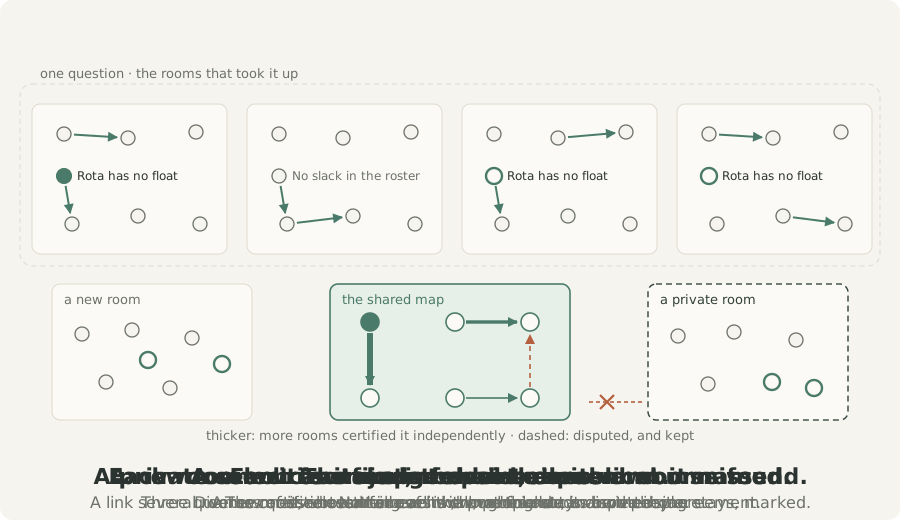
How rooms federate without anyone administering them. One question is published. Rooms open themselves to an email domain, so a confirmed address is the only key. Hundreds of rooms of up to a hundred people run the same question, each splitting its wall into groups of fifteen. Their maps fold into one, which says how many members joined on an address and how many were invited.
Sixty thousand people, nobody administering it: the question is published, an email domain is the door, and the people of a place open its room themselves.

What emerges. The knowledge a hard problem needs is dispersed. No room sees the whole problem; each holds a piece of it. Every room writes its own causes before anything arrives from elsewhere, so the rooms explore before they share. Then a select few, diverse cards travel, and each room judges them like its own. Rooms are not shown each other's verdicts while they judge, so agreement between rooms is found, not copied, and one organisation counts as one voice however many rooms it opens. Where rooms disagree, the pair goes to other rooms, and what they cannot settle is published as contested. What comes out is not a list of the biggest problems but how they drive each other: a causal map no single room could have drawn, thicker where more rooms found the same link on their own. Why the rooms do not follow each other.

A new room may receive what it missed. Once its own people have written theirs, the most relevant causes found by earlier maps on its question, or by the rooms it pools with, can arrive in it; a select few, diverse cards travel between rooms; and a private room — a company's, a hospital's, a ministry's — can take in what the public rooms on its question found, with nothing of its own going out. That is the other half of a swarm: it remembers, a collective memory of what earlier rooms found. Read the finished maps before you open a room; the insight may already be there to build on.

How separate rooms become one swarm. Each room writes its own causes; a select few, diverse cards travel between rooms; each room certifies its own links; the maps fold into one, a link thicker the more rooms certified it on their own; a new room writes first and then receives what it missed; a private room takes in and gives nothing out.
Nobody coordinates the rooms: a select few, diverse cards travel between them, and a link many rooms certify on their own weighs more.

How it works at scale, in full →

Five rules that keep the result fair

So that no single person, faction or loud voice can bend the map. How they were tested.

A split vote is not a “no”

If a group is divided on whether one cause influences another, the pair is not recorded as “no influence”. It stays open, and if nobody can settle it, it appears on the map as disputed.

Another group settles a split

An open pair goes to two other groups, drawn by lot so nobody can pick a friendly one. They answer separately, and both must agree. Which group gets which questions rotates.

An idea with few votes can still be examined

A few shortlist places are kept for ideas that did not get enough votes. Anyone can nominate one by attaching a source; it takes a place once a second person agrees the source is relevant.

Grouping ideas is only for reading

People group similar ideas so a long wall is easier to read. The groups never affect a vote or the result. If they did, whoever drew the boundaries could steer the outcome.

Causes and priorities are decided differently

Whether one cause influences another is a question of fact: three quarters of the votes, then it goes on the map. How important something is, is a question of values: everyone gets the same five votes, and the result is reported, never “agreed”. Requiring three quarters for priorities would erase whatever a minority cares about.

When a fight is about logic, say so

Contested pairs carry two different disputes. The platform separates them, because only one of them has a mechanical answer. Try the logic check →

One word moves. The two premises stay, the two conclusions stay, and the argument goes from forced to fallacious. Groups argue about this for hours without noticing which one they are holding.

What the machine may decide. Whether a conclusion follows is computation, and costs no votes. Whether a premise is true is never the machine's call: it goes to a panel, with the evidence attached.

Questions people ask first

How long does a dialogue take?

A few effective hours per person: about ten minutes to write cards, a short clarification, and the pairs, which take the longest. Spread them over days or take them in a sitting, as the group's focus and the number of cards allow; the steward closes each stage, or a clock does. The map is there to read the moment it settles.

How many people can take part?

From a dozen to tens of thousands. A room splits itself into groups of about fifteen, each with its own wall. Any number of rooms can take up the same question, and their maps fold into one that says how many groups found each link.

Do participants need an account or an email address?

A handle and a password; no email, unless the steward asks for confirmed addresses so that one person is one member. Addresses are never stored, only a keyed hash. Nobody is named inside a dialogue, and a week after it completes the room is sealed: it forgets who was in it.

What does it cost?

Free for up to 100 people. Larger organisations pay by plan; registered nonprofits get the Pro plan free. Plans and prices →

Where does AI come in?

A model can suggest a sharper wording for a question, ask an author a clarifying question, and read an argument into a structure. It never casts a verdict: every link on the map comes from people's votes or from a fixed rule, and you can see which.

What do I get at the end?

A map of root causes with every link showing how it was settled, a record of what the group could not agree on, the actions judged against each root, and a page for every claim that can be cited, embedded or read as JSON. Deciding what to do, and answering for it, stays with you.

Can a room be opened inside an institution without its permission?

Yes. A room can open to a domain, so anyone with an address at a faculty, a hospital or a company can open its room and the rest can walk in. Nobody inside is named, and the map names causes, not people. What the institution receives is the map — usually the first time it has seen the whole picture.

What happens to it afterwards?

A week after it finishes, the room seals: it forgets who sat in it; only the steward's name stays, as the question was published under it. The map, the record of every judged pair, the actions and the predictions stay, with a page for every claim. A campaign can come back a year later and point at exactly what was promised and what moved.

What does the steward control?

The question and its scope, who may join and how, the pace of the stages and when each closes, whether the room is private or listed, and what follows: the actions, the plan, the predictions. What nobody controls is the map itself — not the steward, not any single group in it: a link needs three quarters of the votes cast, and a split goes to other groups. That is what makes the result worth having: nobody can say you steered it.

Can a facilitator run it?

Yes. A steward can be a facilitator, and the Clarify and Structure stages can be held on a call per group with the facilitator holding it. Without one, the rules hold the stages. Facilitators who know Structured Democratic Dialogue can skip the lessons.

Can a private organisation use what public rooms have found?

Yes. A private room can ask to receive the cards from listed rooms on the same question: the causes other people found arrive on its walls, and nothing of its own goes out. Every finished public map and every shared map can be read by anyone, and the form that opens a room says when the question has been asked before.


Standing on published work

The method is Structured Democratic Dialogue: fifty years of peer-reviewed work and hundreds of documented dialogues, from Warfield and Cárdenas to Christakis, Bausch, Laouris and Dye. They named scale as its hardest limit; lifting that limit is what this platform is for. One deliberate departure: nobody is named inside a dialogue, because in a workplace or a divided community the name is what stops people writing the true card.

Polis, Remesh and the Habermas Machine ask what a crowd agrees on. This asks what causes what, and keeps what it cannot settle. The mechanism science, the rules tested against bloc voting and the implementation are what we add.

Bring a question that has been argued about too long.

One group can run the whole thing in a few effective hours, spread as it likes. You finish with a map, a list of roots, a record of what could not be agreed on, and every connection showing how it was settled — a document that outlasts the meeting, the campaign and the people who ran it.

Start a dialogue — free Walk through one first